
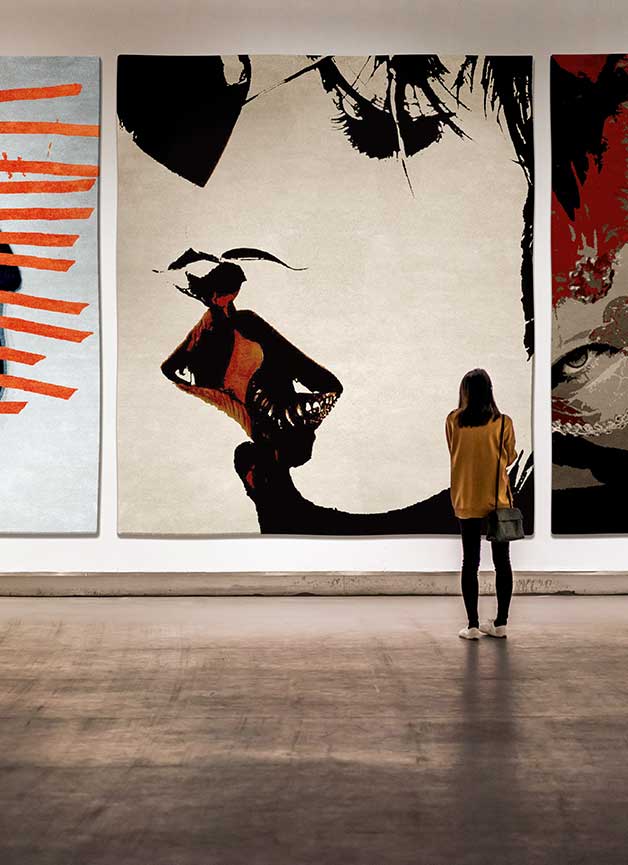
Area rugs are often referred to as carpets. Most of us have many childhood memories growing up with rugs — and they remain great choices for consumers, collectors, and interior decorators alike.
Nowadays the art of rug designing and weaving is no longer a "dying art." Rug designs are no longer limited to the traditional patterns we grew up with. Currently, area rugs are being designed by leading architects and famous fashion designers — Calvin Klein, Angela Adams, Nani Marquina, Gandia Blasco, Gene Meyer, Dakota Jackson, Jessica Miller, Marc Davidson, and many more.
In comparison, wall-to-wall carpeting is mostly purchased in neutral colors — rooms still look empty and furniture still looks scattered. A carefully selected area rug introduces harmony and ties in all the artwork, furniture, and accessories of the room without overwhelming the space.
Being the most prominent item in the room, area rugs can transform a space instantly. They can define an area, create false walls, define hallways, set the parameters of a seating area, and divide a large loft into separate spaces. They are also a smart, practical option for renters — roll them up and load them on the moving truck.
Questions to Ask Yourself
Defining your decorating needs is the key to decorating effectively. Before choosing a rug, consider how long you plan to stay in the space — and answer these questions:
- What type of lifestyle do you lead?
- What is the designated use of each room you are decorating?
- Do you have pets or children?
- Are you planning to start a family?
- How much natural daylight does the room receive? Direct sun?
- Do you entertain a lot?
Each of these questions will help narrow down your selection process and determine whether you need a rug to make a statement — a "Wow Factor" — or something quieter and more practical.
Prep Work — Before Buying a Rug
Always research by looking at interior design magazines before starting a project — Architectural Digest, Dwell, In Style, and Metropolis are excellent starting points. These magazines showcase current colors, newest trends, and real interiors that can help you narrow down your palette and atmosphere.
Whenever possible, start your decorating project from the floor and work your way up — choose the rug first, use its colors as a starting point for the walls, then move to upholstery and accessories. Most times, the rug fills the room with enough color and warmth that you need fewer accessories than you think.
Browse by Mood
Before researching weave types, ask yourself about the atmosphere you want to create. Browse the moods below — you may surprise yourself by knowing which rug is "yours" the moment you see it.
Understanding Construction
There are three general types of rug construction. Rugs fall into different price classes based on whether they are handmade or machine-made.
Hand-Knotted
Hand-knotting takes the longest to complete — each knot is inserted into a vertical loom by hand. The smaller the yarn, the longer it takes to cover a given square inch. Some rugs have as few as 30 knots per square inch; others may have thousands. Plush wool is sheared from sheep grazing at high altitude, hand-carded, and manually spun into fine yarn.
The color master gives the yarn life in dye pots containing hues in every tone, tint, and shade imaginable. A grapher draws and paints the design on a full-scale grid for the weavers, who then work thousands of hours — nimble hands weaving infinite knots until the last row is complete.
The masterpiece is cut from the loom, given a final trimming to bring out beautiful details, then washed and packaged for its journey — ending on the floor of your home as a folk work of art.
Hand-Tufted
Hand-tufting consists of yarn inserted into a pre-drawn design on a backing grid using a tufting gun — a relatively quick process. Once the entire design is filled, the rug is turned over for an application of latex glue and fabric backing.
Machine-Made
Made entirely by machine within minutes, with designs controlled by computer. The yarn is forced into a grid and finished with a latex or fabric backing.
How to Spot Quality
To identify a quality hand-knotted rug, inspect the following:
- Look for the length of the wool fiber, its springiness, and its luster.
- When looking at the back of a rug, the frontal design should be clearly visible — a less-defined reverse side means looser knotting.
- Finer knots denote higher quality. A finely woven rug will have over 180 hand-tied knots per square inch.
- A skilled craftsman ties about 800 knots per hour — a 9×12 rug takes over 3,500 hours of labor.
- Flat weaves (kilims, dhurries) are reversible and perfect for high-traffic areas like entries and kitchens.
- Bright, vivid colors indicate high-quality dyes.
Choosing the Right Size
Allow at least 20 inches from all walls so the rug can breathe. In dining rooms, be sure chairs can be pulled out without falling off the rug. In bedrooms, the rug should extend at least 25 inches past the three sides of the bed. When in doubt, go slightly larger — a too-small rug is one of the most common decorating mistakes.
Area Rug Decorating Tips
- Decide where you will use the rug and choose the atmosphere you want to create before anything else.
- As long as the colors coordinate, it is perfectly acceptable to use more than one rug in the same area.
- Place a rug pad underneath to prevent sliding and extend the life of the rug.
- If possible, choose the rug first — harmonizing a rug with existing fabrics and wallpaper is harder than the reverse.
- Take color or fabric samples with you when shopping to replace a rug in an already-decorated room.
Eco-Friendly Rugs
Organic Weave: Collections like Calvin Klein Organics are hand-woven by skilled artisans using all-natural, reusable organic materials — supporting hundreds of remote villages and farming communities worldwide.
Bamboo: Bamboo has quickly become the most popular eco-friendly natural fiber. Its fibers have a luminous sheen, are soft like cashmere, naturally stain resistant, hypoallergenic, and antimicrobial. Bamboo is sustainably grown without pesticides or fertilizers.
Jute & Sisal: 100% biodegradable, durable, sustainable, and inexpensive — these natural plant fibers lend a calming, natural look in a wide range of settings, and their increased use can have a dramatic effect on reducing oil consumption.
Recycled Materials: Nani Marquina's Bicicleta is made from recycled bicycle tires. Nani Marquina is a member of Care & Fair, an organization dedicated to eradicating child labor in rug-making countries. Shaw brand nylon rugs use Type 6 nylon — the only post-consumer fiber capable of being recycled into new carpet fiber.
Tibetan Rugs: Made entirely of natural fibers that require no energy or oil to manufacture and are fully biodegradable. Designed and made to last a lifetime — and then passed on to the next generation as a precious, enduring work of art.